
By: All Psychology Schools Staff
Updated: October 13, 2026

By: All Psychology Schools Staff
Updated: October 13, 2026

The main difference between a Doctor of Psychology (PsyD) and a Doctor of Philosophy (PhD) in psychology is the emphasis of the training. PsyD programs generally emphasize applying psychological science through clinical practice, while PhD programs generally place greater emphasis on research and the generation of new knowledge.
Both degrees can prepare graduates for careers as licensed psychologists, although specific licensure requirements vary by state and program.
There are, however, other less common degrees that can train you to work in psychology in a highly specialized way, and you can read more about those options later on.
According to the American Psychological Association (APA), PhDs are “intended for students interested in generating new knowledge through scientific research (i.e., setting up experiments, collecting data, applying statistical and analytical techniques) and/or gaining teaching experience.” There are more PhD programs in psychology compared to the number of PsyD programs.
The Doctor of Psychology degree was introduced in the 1970s as an alternative for students who were less interested in conducting ongoing psychological research and more interested in providing psychological services to patients and the public. Per the APA, “the focus of PsyD programs is to train students to engage in careers that apply scientific knowledge of psychology and deliver empirically based service to individual, groups, and organizations.”
On top of the focus of each degree, there are other differences and similarities to consider.
| PhD | PsyD |
| Admission requirements: Master’s (possibly bachelor’s), high GPA, essays, interviews, and letters of recommendation | Admission requirements: Master’s (possibly bachelor’s), high GPA, essays, interviews, and letters of recommendation |
| Program length: Usually 5–8 years, but varies | Program length: Usually 4–6 years, but varies |
| Courses and training: Research, statistics, and teaching methodologies. An APA-accredited internship is also required. | Courses and training: Applying knowledge directly to psychology practice with individuals and groups. An APA-accredited internship is also required. |
| Doctoral project: Dissertation | Doctoral project: Possible dissertation or equivalent project |
| Funding: Waived tuition and stipends in exchange for teaching or research assistance | Funding: Tuition coverage not common, but possible stipends through assistantship |
| Licensing and certification: State licensing required, certification optional | Licensing and certification: State licensing required, certification optional |
| Career options: Often research lab and teaching positions, as well as applied practical roles | Career options: Direct client care in positions like counseling, social work, human services and consulting |
The processes of applying to PhD and PsyD programs is very similar. Many programs require you to already have a master’s degree in psychology or a related field, though it’s possible to find combined master’s/doctoral programs that accept students who only have a bachelor’s degree. Others still may accept students with a bachelor’s degree directly without awarding a master’s degree.
You’re also likely to need a GPA of at least a 3.0. Some programs require or recommend standardized test scores, while others do not. Many schools also require you to write personal essays, undergo interviews and submit letters of recommendation.
For most students, PsyD programs take roughly four to six years to complete. Due to the stronger emphasis on extensive research, PhD programs typically take between five and eight years. However, program lengths can vary considerably—always check with schools directly to learn how long their program will take.
The training you receive in a PhD program focuses on research that leads you to producing new scientific knowledge. PsyD programs emphasize training that allows you to apply your knowledge in a practical setting, though you’ll likely still conduct some research.
In both programs, you’ll be required to participate in an internship for at least a year. As with your program itself, these internships should be accredited by the APA. Choosing a program or internship that’s not accredited could make it difficult to get your license.
In a PhD program, you’re required to complete and defend a dissertation. Many PsyD programs also require a dissertation or equivalent doctoral project, likely designed to demonstrate different skills than research-driven PhD dissertations.
Financial aid can be an incredibly important part of selecting the program and school you attend. Most PhD programs waive a student’s tuition and provide a stipend for assisting with research or teaching. While you’ll likely be in school for a longer period of time, you may be able to graduate without any debt.
This typically isn’t the case for PsyD programs, however you may be able to find schools that provide stipends for assistantships. Graduates of PsyD programs are more likely to leave with student debt, though the potential to graduate in less time means you can find work and start earning a salary earlier.
Whether you hold a PhD or PsyD, to officially call yourself a psychologist, you need to be licensed in the state where you work. Requirements vary slightly by location, but you’ll have to pass the Examination for Professional Practice in Psychology (EPPP).
The Association of State and Provincial Psychology Boards (ASPPB), who developed the EPPP, introduced the EPPP (Part 2-Skills) in 2020. This means the EPPP now consists of two parts: the EPPP (Part 1-Knowledge) and the EPPP (Part 2-Skills). Only candidates for licensure in jurisdictions that have adopted the EPPP (Part 2-Skills) are required to take it.
Becoming certified isn’t required to work as a psychologist, though you may want to seek out board certification to support that you have the proper knowledge in your chosen subfield. Certification may also earn you better job opportunities and potential financial benefits. These credentials can be gained through the American Board of Professional Psychology.
Those with PhD and PsyD degrees can still pursue many of the same career opportunities, including but not limited to:
The biggest difference in jobs is in the world of academia. If you wish to pursue a position that involves research or teaching, a PhD may prepare you better. If you know you only want to apply your psychology training in a more client-facing capacity, a PsyD may provide you with more advanced knowledge in that area.
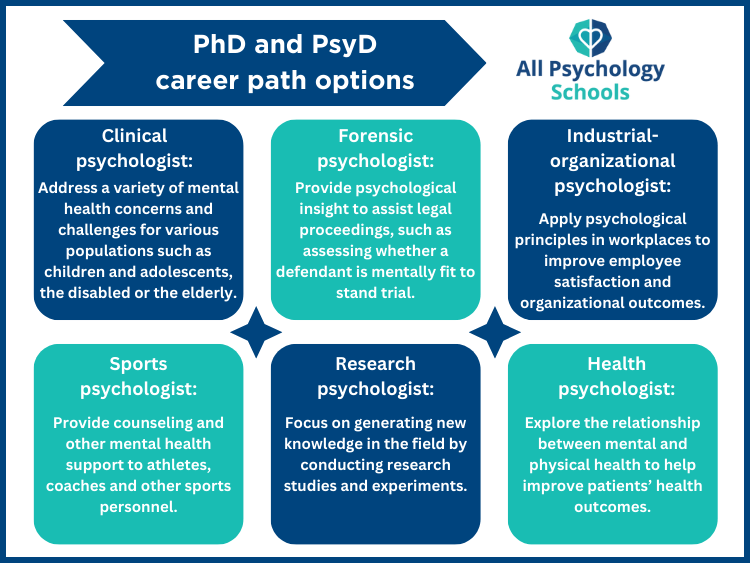
Choosing which degree to pursue ultimately comes down to your career goals. But sometimes it can be hard to know what exactly you’ll want to do that many years in advance. The solution can come by applying to a variety of programs and using the interview process to determine the best fit. Ask questions such as:
A third degree option is a Doctor of Education (EdD) in Psychology, though this is far less common. Those who pursue these degrees typically do so to apply their training to educational and developmental fields. This can often mean working in school psychology or in areas of special education. These degrees could also be applied to the field of educational psychology, which studies how students learn and what keeps them motivated in order to develop curriculum and technology.
Another less common degree is the Doctor of Business Administration (DBA) in Industrial and Organizational Psychology. These degrees are designed specifically for students who want to pursue high-level roles within business organizations. Training involves teaching the assessment of employee behavior in order to implement policies and procedures that help a company meet its goal while maintaining employee relations and proper conduct.
As previously stated, the program type that makes the most sense for you depends on your career goals.
A PsyD may be worth considering if you want to:
A PhD may be worth considering if you want to:
If you’re still unsure, consider speaking with admissions personnel or faculty members of individual programs. They can often help determine if their program would be a good fit for you based on your goals.
Not necessarily. Acceptance rates vary considerably by institution, program size and applicant pool. Some PsyD programs admit larger cohorts, while some PhD programs admit only a small number of students each year. Rather than comparing degree-wide acceptance rates, prospective students should review the admissions statistics and requirements for individual programs.
Both PsyD and PhD programs can prepare students for careers as clinical psychologists. PsyD programs typically focus more heavily on clinical training, while PhD programs generally combine clinical training with more extensive research preparation.
PsyD programs can be more expensive than PhD programs, particularly because many PhD programs provide funding through assistantships, stipends or tuition support. Costs and funding opportunities vary significantly by school, so prospective students should compare total tuition, financial aid and expected debt.
Yes, PsyD graduates can pursue teaching positions, particularly in applied or professional psychology programs. However, PhD programs generally provide more extensive research training, which may be important for academic positions that emphasize research and publishing.
Yes, graduates of relevant PhD programs can pursue careers providing psychological services, provided they meet applicable state licensure requirements. A PhD in clinical or counseling psychology can include substantial training in assessment and psychotherapy.