Learn How to Become a Psychologist: Find Your Education Path
Have you got what it takes to become a psychologist? Find out here.
Americans suffer from many different kinds of depression, substance abuse, and other anxieties, phobias and mental health issues. According to the Center for Disease Control and Prevention, about 25% of all U.S. adults have a mental illness in any given year, and 50% of us will develop one during our lifetime. Psychologists play a big role in helping people deal with these widespread problems.
Psychologists are non-medical doctors (as in PhD) who specialize in the study of the mind and human behavior. They help people overcome fears and anxiety, relate better to friends, family and colleagues, and generally lead better lives.
The field of psychology is vast, and once you finish your education and become a psychologist, your actual job duties will depend on your chosen specialty, theoretical orientation and the populations you choose to serve.
Psychologists practice in different ways. They do counseling or research, offer psychotherapy, conduct personality tests, and teach in colleges and universities. Clinical psychologists help people overcome problems that keep them from leading happy, more fulfilling lives, and improve the mental well being of their clients.
They may also practice forensic psychology and testify in court, help choose jurors, or determine competency to stand trial. The focus you choose is up to you.
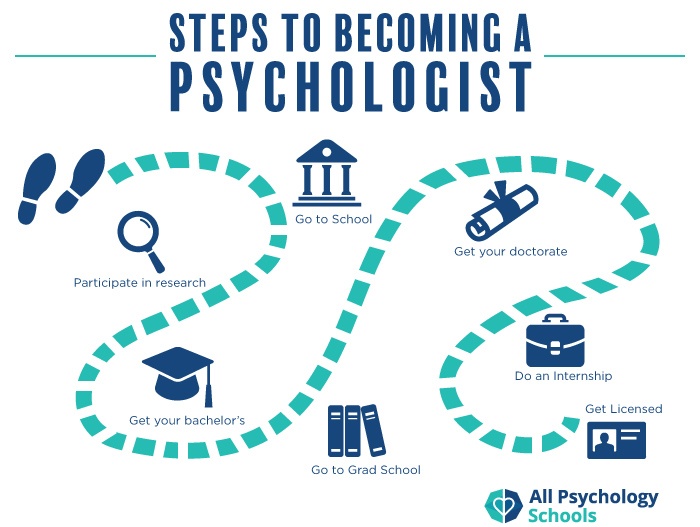
To protect the public and make sure psychologists are highly trained professionals, all states require that you get a license to practice. Below are the steps for becoming a psychologist:
First, earn a bachelor’s degree: Psychologists often start by earning a bachelor’s degree in psychology. Prerequisite courses include general psychology, experimental and developmental psychology, and statistics.
It’s helpful to gain experience while you’re in school: If you’re interested in experimental psychology, help a professor with her research project. Work with handicapped children, if you’re interested in developmental psychology. Volunteer in a mental health clinic, if you’re interested in clinical or counseling psychology. If you get hands-on experience during your psychology degree, you may find it easier to find a job after school.
Research graduate programs: Learn about the various programs to find the psychology master’s degree that’s best for you. The school you choose will depend on your interests and the specialties of the faculty at the schools you’re considering.
Choose a degree and specialty: Which field is right for you, clinical psychology or counseling psychology? Research psychology or industrial-organizational psychology? Will you need a master’s degree, PsyD, PhD, EdD or EdS?
Complete a doctorate in psychology: Most fields of psychology require a doctorate. Psychology graduate schools look for a competitive score on the GRE (1200 or more), a GPA of 3.3 or higher, and volunteer or paid experience in the field.
Do a psychology internship: States normally require you to do a two-year supervised internship. This is a good idea for many reasons: you get on-the-job training, you learn whether a certain specialty is right for you, and you get the satisfaction of helping others. Internships in clinical and counseling psychology may need to be approved by the American Psychological Association (APA) because jobs in mental health sometimes require an APA-approved internship.
Get licensed to practice psychology: All states require you to fulfill certain requirements before they’ll grant you a license. You must also pass a national exam and, in some cases, present a case study to a board of psychologists. Check your state’s requirements early.
There are accredited psychology schools at the bachelor’s, masters and doctoral level in every state, and the one you choose depends on a lot of factors.
You may also choose a bachelor’s, master’s, or doctoral program because of its faculty (psychology professors you want to study with and who can help you when you decide to do your master’s work or doctoral dissertation), or because of other considerations such as tuition and location.
There are also online psychology schools that can help you get the education you need. The school you choose is up to you, and it’ll depend on your needs, career goals, and many other factors.
Differences Between PhD, PsyD, EdS, and EdD Degrees
A PhD (Doctor of Philosophy) is the traditional psychology degree that places an equal emphasis on research and clinical training. PhDs in psychology are offered by traditional universities and are highly competitive.
A PsyD (Doctor of Psychology) is a practical degree offered by professional schools of psychology, and it will emphasize clinical practice with only a minimum of emphasis on research. Entrance into PsyD programs is less competitive than for PhD programs, and if you want to help people with counseling or psychotherapy, this is the degree for you.
Many students pursue an EdD in psychology to increase their skills (and their pay) if they work in schools, while others use it to change careers and work as professors, in hospitals or in private practice.
The EdS is a unique degree, and is normally offered by university departments of education. It’s the only non-doctoral degree you can get that will let you practice psychology, and it leads to jobs in school psychology.
Psychologists and psychiatrists are doctoral-level clinicians, but psychiatrists are medical doctors and only they can prescribe medications. These medications help their clients deal with depression and PTSD, overcome substance abuse, and more.
Commonly, patients will see psychiatrists to discuss how their medications are affecting them (and adjust dosage or change medications, if needed), while also attending therapy sessions with a counselor, therapist or psychologist. Psychiatrists do most of their training in medical school and spend the last three years learning about mental health during a psychiatry residency.
If you choose to become a psychologist, you’ll spend your entire graduate education learning about mental health (typically 5-to-7 years), followed by a supervised internship. Psychologists and psychiatrists both help people deal with emotional issues, but licensed clinical and counseling psychologists must have a doctorate in psychology, which requires 5-to-7 years of postgraduate work.
By point of comparison, most licensed therapists and counselors have a master’s degree, which requires 2-to-3 years of postgraduate work.
There are several good reasons to earn a psychology degree. First of all, it’s required to practice psychology. It’s also one of the most popular undergraduate degrees in the country.
Not everyone who studies psychology ends up working as a psychologist, but a psychology degree can open up many doors and pave the way for any number of careers in companies and organizations across the U.S.
However, the main benefit of a psychology degree is that it will allow you to either do the kind of research you’re interested in or directly help people lead happier, more satisfying lives.
In your practice, you’ll learn new things every day, challenge your beliefs, and get to exercise your problem-solving skills to help others. What could be more rewarding than that?
To start a psychology career, you’ll need to get at least a master’s degree (for school psychology) or a doctorate to practice in other specialties.
To get licensed to practice psychology, you’ll need to earn the required degree, pass a state and/or national exam, and fulfill other licensing requirements.
But your practice of psychology really starts during your supervised internship. Internship requirements vary, but it generally takes two years to complete your supervised practice (about 3,500 hours), at least one year of which is done after receiving your doctorate. Working under a mentor takes some of the pressure off, and he or she can advise you when you have questions or work with hard-to-treat clients.
Once you’ve successfully finished your internship, you can apply for a license, and begin practicing on your own.
Clinical Psychologists are trained in psychological theories and treatment methods.
Psychiatrists are trained medical doctors with a specialty in psychiatry. Their emphasis is on the biological causes of mental disorders, and they treat patients by prescribing medication.
School Psychologists are trained in psychology with an emphasis on education and child development.
Psychoanalysts delve into the unconscious mind and may have any number of theoretical orientations: cognitive, behaviorist, existential, and more. Psychoanalysis is commonly used to treat depression and anxiety disorders.
Licensed Social Workers help people gain access to the support they need, and they have supervised internship requirements similar to psychologists.
Marriage, Family, and Child Counselors study psychology, therapy, counseling or social work, and they help couples, families, and parents and children improve their relationships, find strategies to overcome problems, and work together for the good of the family.
Once you’ve finished your psychology degree and done your internship, you’ll need to think about where you want to work. Psychologists work in many different environments, including the following:
Government agencies
Hospitals and clinics (including VA hospitals)
Management consulting firms
Marketing research firms and other businesses
Nursing homes
Rehabilitation centers
Schools and universities
Social service organizations
Approximately two-thirds of all psychologists are self-employed and maintain a private practice.
Psychologists can make a good salary for the work they do.
But just how much can you make as a psychologist? This really depends on where you work (including in which city and industry) and the kind of psychology work you do. Below are median salaries for three psychology specialties according to the U.S. Bureau of Labor Statistics’ 2022 data.
Career
Median Annual Salary
Clinical and Counseling Psychologists
$96,100
Industrial-Organizational Psychologists
$147,420
School Psychologists
$84,940
Based on national data, not school-specific information. Conditions in your area may vary.
So if you already know that you want to become a psychologist, take the next step. Research schools, find out which one is best for you, and apply for financial aid to make your education more affordable.
Then, learn about human behavior and help people act in ways that make them happier and more productive members of society. We sure need more qualified people doing valuable work like this, don’t you think?